
Interview by Chris Pederson
1. You were raised on a dairy farm near Adrian in southern Minnesota. What do you remember most vividly about that childhood, and which lessons from farm life still guide you today?
I grew up on a small dairy farm outside Adrian, in the far southwest corner of Minnesota. What stands out most, looking back, is how early the days started and that there was never a day off. The cows had to be milked every day. My parents expected all of us kids to pull our weight, and there wasn’t much room for excuses. That’s stayed with me my whole life. You show up whether or not anyone’s watching, and most problems get solved by outworking them rather than talking your way around them. It’s a lesson I carried into the Army, into the courtroom, and now into this campaign.
2. You and Janet were high school sweethearts and have now shared most of your adult lives together. How did the two of you meet, and what has a long marriage taught you about partnership, patience and keeping life in perspective?
Janet and I met when we were in high school, and we started dating at the end of our sophomore year. She was the smartest and prettiest girl in our class. Every year we celebrate the anniversary of our first date. We dated all through high school and got married while we were still in college. It was the best thing that ever happened to me.
Janet is an amazing person. She is the only person in our family to have actually won an election. She was elected to the Wayzata School Board twice. She served seven years and was Chair of the Board for two of those years. She also served on the board of Interfaith Outreach and Community Partners for 12 years and did two stints as Board Chair. She has served on several other nonprofit boards and has been a leader in our community. I’m actually better known as Janet’s husband than as a successful lawyer.
Janet has been my rock. Whatever I’ve accomplished in my life I could not have done without her unwavering support. She is my most important and trusted advisor. She is the first person I talk to in the morning and the last person I talk to at night. She has great instincts and they are far better than mine.
3. You and Janet raised three children and are now grandparents. What are you proudest of as a father and grandfather, and are there family traditions or values you especially hope to pass on to future generations?
Janet and I raised three children, and we’re now the proud grandparents of three grandchildren. All of our children are successful and accomplished. They take after their mother.
Two of our children live in London and the third, with the grandchildren, lives just a few miles from us. Despite two of our children living in London, we have a close-knit family, thanks in part to Facetime, an iMessage group, and Delta Airlines. We really enjoy spending time with our adult children. And we especially enjoy spending time with our three grandchildren, who we see every week and who amaze us with their latest exploits.
4. What brought you and your family to Medina, MN and what have you come to appreciate most about the community, its people and the everyday rhythm of life here?
After I completed my military service, we wanted to return to Minnesota. We were attracted to the Western Suburbs by the good schools, especially the Wayzata school district. We lived in Maple Grove for a couple of years after I got out of the Army but then moved to Plymouth to be in the Wayzata school district. 25 years ago, we moved to Medina because we wanted to live in a more rural setting on a larger property. We absolutely love it here. We have great neighbors.
5. Before becoming a lawyer, you studied mechanical engineering at Marquette University on an Army ROTC scholarship. What originally drew you to engineering, the military and ultimately the law—and how has each shaped the way you approach problems?
I enjoyed math and science in high school. I was a good student and in addition to enjoying math and science I loved to read. From an early age I thought about being a lawyer even though we had no lawyers in our family and I didn’t know any lawyers. All I knew about lawyers I learned from watching Perry Mason. But I did have people tell me that I shouldn’t pursue the normal undergraduate route to law school which would have been studying political science. So, I decided to study engineering as I could always fall back on that if the law thing didn’t work out.
Because my parents couldn’t afford to pay for college, I had to figure out how to pay for college on my own. I started exploring various scholarship opportunities and an ROTC scholarship was an attractive option.
The combination of engineering and law was a good one for me. After my stint in the Army JAG Corps where I handled all criminal cases, my civilian career was mostly high-tech litigation, including a lot of patent litigation. I really enjoyed learning about different industries and technologies and translating complex technical information into a form that non-technical jurors could understand.
6. Your first legal work was in the Army JAG Corps, where you served as both a defense attorney and a prosecutor. Which experience, mentor or lesson from those years had the greatest influence on the man and lawyer you became?
I spent the first half of my time in the JAG Corps as a defense counsel and the second half as a prosecutor, which is a fairly rare path, and it shaped me enormously. As a defense lawyer, you learn that everyone, no matter what they’re accused of, deserves someone in their corner who will hold the government to its burden of proof.
My first boss and mentor in the JAG Corps was my supervisor, Major Tim Cork. He was the chief of the Trial Defense Service at Fort Ord where I was stationed. As a young lawyer I was very aggressive and stepped on some toes. Major Cork ran interference for me.
As a prosecutor, you learn what it means to represent the United States of America and to use that power responsibly, pursuing a conviction only when the facts and the law actually support it. Standing in a military courtroom in my twenties and saying, ‘I represent the United States of America,’ is something I’ve never forgotten.
7. Across your long career in the courtroom, is there a client, case, mentor or turning point that has stayed with you—not simply because of the result, but because of what it taught you about people, fairness or perseverance?
The case that turbocharged my career was Fonar v. General Electric where I represented the inventor of the MRI machine, Dr. Raymond Damadian, and his company in a patent fight against General Electric. Dr. Damadian was a visionary and a pioneer. At the time we sued General Electric, General Electric was considered the most powerful company in the world and they had teams of lawyers from four different law firms representing them. We tried the case in New York and won $110 million. That verdict saved Dr. Damadian’s company. What that case taught me, and what has guided my whole career, is that a courtroom is one of the few places left where an individual with the truth on their side can stand toe-to-toe with the most powerful interests in the world and win. That’s the same fight I want to bring as Attorney General: standing up for regular Minnesotans against fraud and abuse of power, no matter how big or well-connected the other side is.
8. You eventually became chairman of a major national litigation firm and helped mentor younger generations of attorneys. What have you learned about earning trust, bringing out the best in people and leading through difficult or uncertain moments?
When I became Chairman of my law firm, I applied the same leadership principles I’ve applied throughout my life and career. A non-exhaustive list: lead by example; don’t ask anyone to do something you wouldn’t do; always do the right thing even if that is the hard thing; spread the credit; own your mistakes; be willing to change your mind.
I always looked for every opportunity to give younger lawyers important roles on my cases, including getting them on their feet in front of judges and juries. I always involved the younger lawyers on my case teams in client meetings and strategy sessions.
9. You have spoken publicly about facing a rare form of leukemia, enduring chemotherapy and rebuilding your strength sufficiently to run the Boston Marathon. How did that experience change your outlook on health, family, gratitude and the value of time?
In June of 2016 I was diagnosed with a rare but highly treatable form of leukemia. I was treated with chemotherapy that took a serious toll on my body. After leaving the hospital on July 5, 2016, I got winded just walking to the end of my driveway. I decided the best way to hasten my recovery was to push myself to walk a little farther every day and eventually start running again. I also decided I needed a goal and a deadline, so I secured a spot on the Leukemia & Lymphoma society team for the April 2017 Boston Marathon. Training was hard, really hard, but nine months after leaving the hospital I ran the Boston Marathon.
I, as a cancer survivor, just like all other cancer survivors, appreciate every day that I’m alive. Going through this experience also reinforced the importance of discipline and perseverance in overcoming obstacles.
10. You have climbed Mount Kilimanjaro, trekked to Everest Base Camp and Machu Picchu, participated in marathons and triathlons, and even completed a solo skydiving jump. What draws you to physically and mentally difficult adventures, and which experience produced your favorite story?
I believe in doing hard things and that is one of the important pieces of advice I give to younger people. If you do hard things, it gives you confidence. If you’ve run a marathon, you know that the way you accomplish something hard is just keep putting one foot in front of the other. Hard physical things like marathons and triathlons also involve being mentally tough. Then when you are confronted with challenges and obstacles in your life you can draw upon the mental and physical toughness you’ve developed by doing hard things.
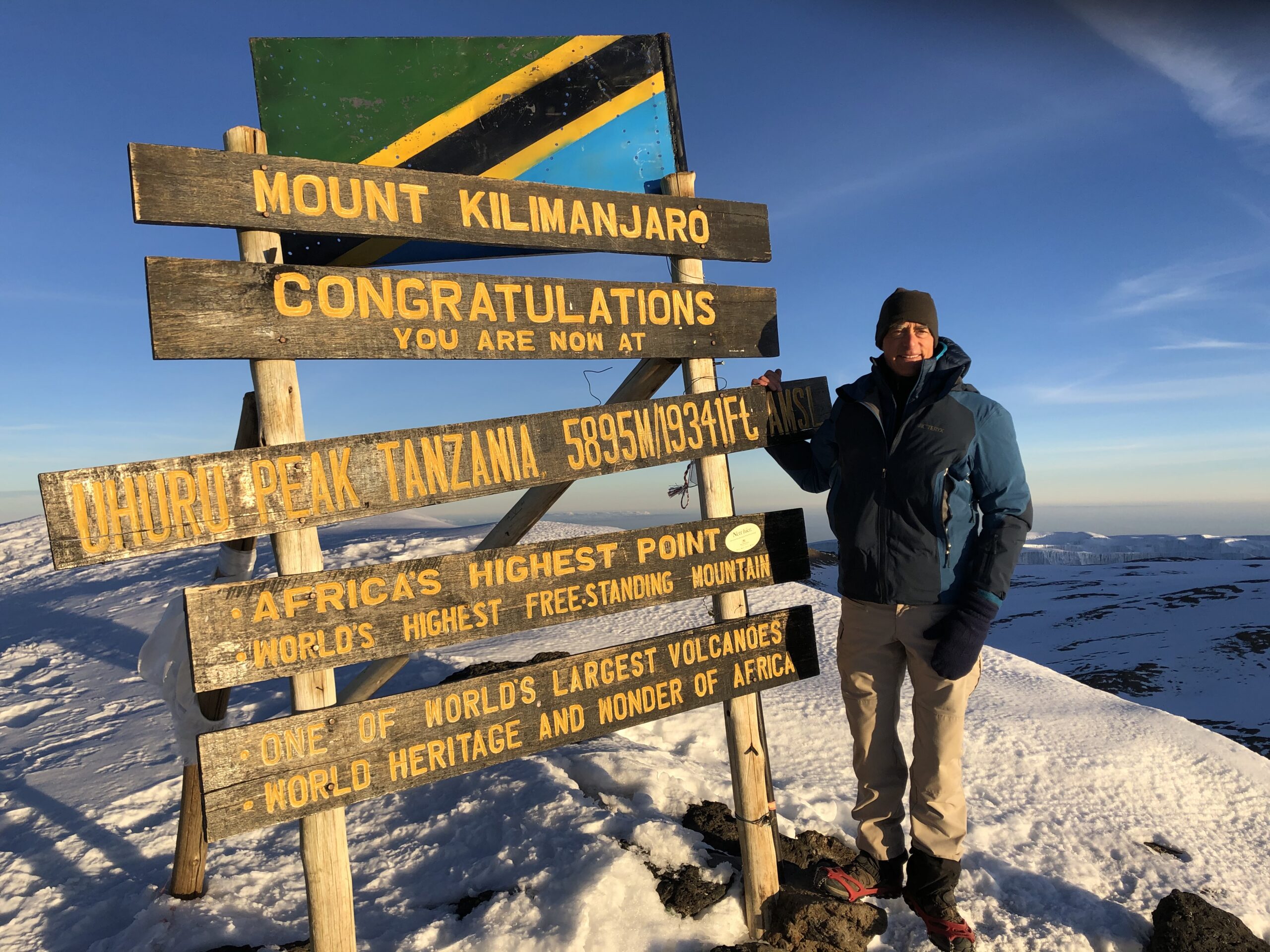
I’ve got a lot of stories from my adventures, but I’ll just relate one here. On March 6, 2020, I flew to Tanzania to climb Mount Kilimanjaro. Covid was already a significant concern, and the President had already halted flights from China to the US. I landed in Tanzania late on March 7th. On March 8th I met the other four climbers and the lead guides. On March 9th we started climbing and as soon as we started our climb, we lost cell phone coverage and all contact with the rest of the world. It wasn’t until March 13th that we were high enough up the mountain that we had cell phone coverage. I called my wife Janet and asked what was going on in the world. She said that the previous day, March 12th, the President had closed the borders for all flights to the U.S. except those carrying only U.S. citizens and that any such flights could only land at a few selected airports which had not yet been designated so we didn’t know how I was going to get back. She also said the stock market crashed and that there was a general sense of panic all around. With that good news we continued our climb and summitted on March 16th. We got off the mountain on March 17th and I flew back to the U.S. on March 18th. I had to fly back through Detroit instead of Minneapolis because it was one of the designated airports to receive U.S. citizens returning from abroad. On the return trip I flew through Amsterdam and going through the airport there, which is one of the busiest in the world, was like walking through a ghost town. The whole experience was surreal.
11. You have devoted considerable time to organizations supporting veterans and to other community and charitable causes. What makes that service personally meaningful to you—and when the professional résumé is set aside, how would Janet, your children and your closest friends describe Ron Schutz?
I’m a veteran and my father was a veteran. Neither of us ever deployed to a war zone. But one of my sons served in the Army and did combat tours in both Iraq and Afghanistan. Seeing what he and his comrades in arms went through caused me to ask what I could do to support veterans. It was during his time in the Army that I joined the board of a charity called Tee It Up for the Troops, which hosts charity golf tournaments to raise money to support wounded warriors. Even though I’m not a golfer, I was really drawn to the mission of this organization. I’ve seen the work they do and how they change lives. It is a great organization.
You’ll have to ask Janet, my children and my friends to describe me but I’ll offer some speculation. I think Janet would say that I’m a loyal and dedicated family man. I think my children would describe me the same and add that while they were growing up I was tough but fair. I think my friends would describe me as loyal, intense, and driven.
12. Why are you running for Attorney General of Minnesota?
I’m running for Attorney General because I love Minnesota. I think the current AG’s agenda is driven by politics and the pursuit of national headlines. I will put the interests of Minnesota and its taxpayers ahead of politics.
On the campaign trail people have repeatedly told me that they want a real lawyer as Attorney General and not a career politician. I began my career as a military prosecutor. After leaving the Army, I’ve spent my career in courtrooms fighting for people against powerful interests.
Minnesotans have for years watched fraudsters drain billions of taxpayer dollars out of programs meant to help vulnerable people, and they want people held accountable. I’ve spent more than thirty years taking on some of the most powerful companies and interests in the country and winning real verdicts for real people. I know how to build a case, how to hold wrongdoers accountable, and how to win in a courtroom, not just at a press conference. Minnesota needs someone who will use that office to fight fraud aggressively and keep our communities safe. That’s why I’m running, and that’s the fight I’m ready to lead.