
An interview with Corcoran Mayor Tom McKee,
2026 Republican candidate for Minnesota House
By Brandon Ferdig, The Periphery
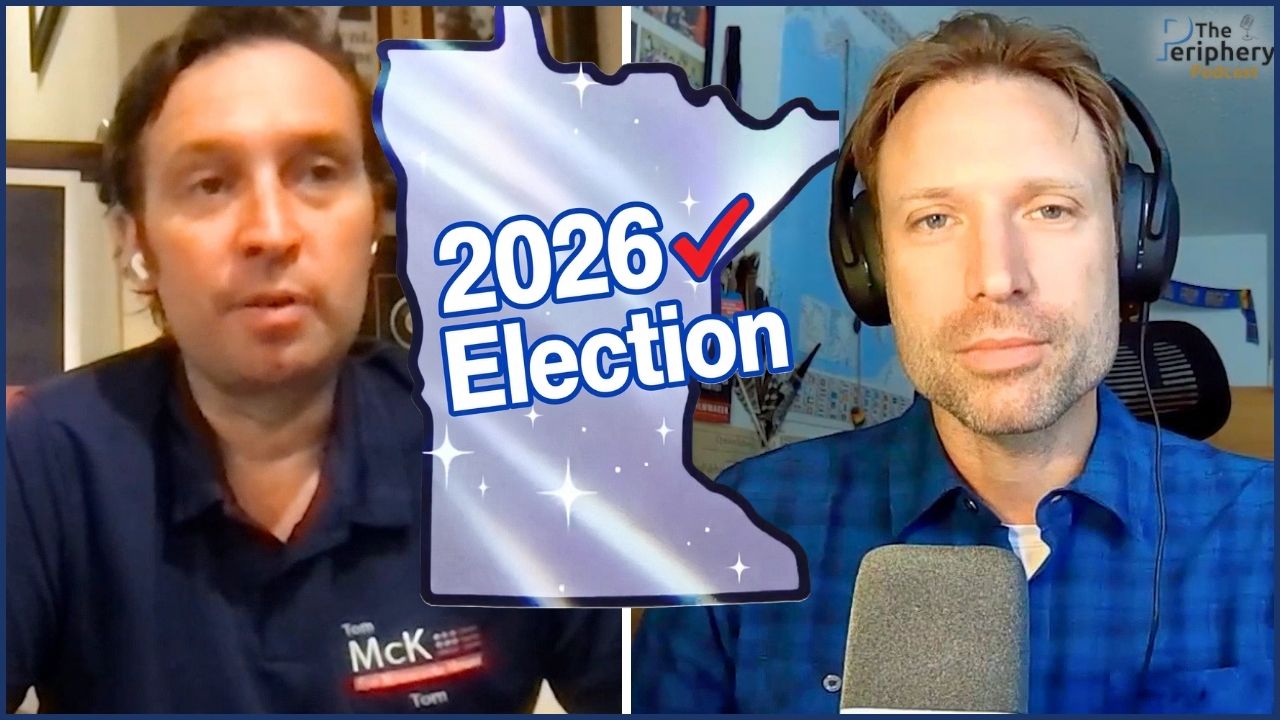
On August 25, local writer Brandon Ferdig sat down with Tom to discuss his campaign for district 37B, his role as mayor, and a unique opportunity for Minnesota to start a new chapter this fall.
Note: This interview has been edited for length and clarity. An extended version can be watched on Brandon’s YouTube channel, The Periphery.
Brandon: What do you like to say regarding your experience as mayor of Corcoran and how that’s led to your decision to run for the House?
Tom: I ran for mayor for the first time in 2020, which was a unique time to get involved in politics and go outdoor knocking for the first time, in the middle of the craziness that was happening then. But I got involved at the local level, was able to win, and have been fortunate enough to be re-elected twice. So, I’m in my third term right now.
I love it. Maybe a year ago I was not thinking this would be where I’d be sitting in twelve months. But as Representative Robbins was done… You know, she has become a very good friend of mine and has done great work in our district and for our state. She ran for governor, and unfortunately, it didn’t work out. She was very encouraging for me to throw my hat in the ring. Some other people called and encouraged me to give it a shot. And so I did.
Brandon: Things can last a long time in politics… and also, things can change so fast.
Tom: Yeah, it’s a mixed bag having so much turnover. I think there’s somewhere in the range of 46 incumbents, or something like that, between the House and both parties, that are not running for their same legislative seat. So, if a handful of incumbents lose either way, you’re talking 50 to 60 people changing between the House and the Senate. That could be a lot of new people, plus a new governor regardless, a new attorney general eventually, a new senator. It’ll be a lot of change at the state level in Minnesota, and at the federal level too. I think it’s good to get some new blood in there and new ideas. You also lose a lot of institutional knowledge.
Brandon: Boy, the way you laid out like that is actually pretty powerful. I don’t know how much, historically, turnover there has been, but this sounds more than usual. It’s been a turbulent last 5-10 years in this state. And so, a chance, I guess, for a fresh start, a new start.
Tom: Yeah, just in general, getting new people in there that don’t have negative associations or relationships already with each other. Maybe we’ll see some more bipartisanship and get some things done. There’s more than enough work to be done to help clean up our state and try to right the ship, get it going in the right direction here, quick—especially economically, financially, the fraud issue obviously being a major one.
I’d rather have the days of growing up, going to college out of state, and people would always ask, “Minnesota—you’re the state that had a wrestler as a governor.” Yep, yep. That was a spectacle.
Brandon: Prince, Jesse Ventura…
Tom: Yep, “Fargo” the movie. There’s a lot of big, big companies headquartered here. And that’s a concern of mine—not that they’re here, but that we’re heading in a direction where we’re going to start losing some of them. And it’s hard to measure, but what companies could be started here, or be coming here, that aren’t, given the business environment and the regulatory environment we have in Minnesota? We have, I think, the second-highest corporate tax rate in the country.
So that’s something that I’m hopeful a House Republican majority, and a gubernatorial candidate, and a Senate majority would be able to help change. That’s a big reason why I’m running. I’m a small business owner as well, a family business. And it’s impactful to businesses, big or small. So, I think it’s something we need to try to address quickly.
Brandon: Was that a reason you jumped from mayor to state representative candidate, because you wanted to help steer the direction of the state?
Tom: I’ll say this: it was an incredibly difficult decision to potentially leave the city early, if I am elected. It was kind of one of those things where the opportunity arose, and people thought that I could help out, and I’d be a good candidate to try to help where I can in different capacities.
With my local government experience: I got a law degree from the University of Wisconsin, got a business degree from Wake Forest University, and I grew up back here going to Wayzata and then Providence Academy—if you’re familiar with that—out in Plymouth. So, I kind of have a pretty wide-ranging background in terms of the legal side, and local government, and business, and then obviously the family business. We’re a general contractor that my grandfather founded in the late ’50s, and my dad and I run it today. So, kind of all over the place, but it gives me some varied experience, I think.
This feels like it’s still a localized enough level of government that you can really hear the feedback; you interact with the people that you’re representing. That, to me, is a big reason why I did it. I did get into politics and become mayor in the first place to try to help our community out. And it’s kind of the same thing there—just a different set of issues, a slightly bigger group that I’d be representing.
Although I will say Corcoran is growing incredibly fast. We hit 10,000 this past summer, which we were about, I think, like 5,800 when I took office in 2020 or 2021. So, we’re growing. We’re one of the fastest cities in the state.
Brandon: Often when we hear “fastest growing” or one of the fastest growing, that’s a bragging point. But I’m guessing there are people in Corcoran that don’t agree with that.
Tom: Yeah, absolutely. We’ve certainly had some growing pains, a lot of varying opinions in the community. And sometimes it’s different opinions when your farm is not developable versus when it is. So, we kind of have a nice balance. I mean we’re seeing some development out there that’s more open space, large lot development but not the same that you’re seeing on the east side. So, it kind of gives us a little bit of best of both worlds in my opinion.
Brandon: It sounds like you’ve been able to balance the growth in a manageable way.
Tom: Yeah. It’s worked well for us. And we’ve seen a lot of residential growth not just in Corcoran but in the area in general. And now it’s starting to get a little bit more into the commercial industrial side of things, which is great just because it starts diversifying that tax base.
Brandon: This might be a dumb question, but what does a city do if it has a surplus? Because you grow so fast and then suddenly you see your tax base shoot up and your revenues go way up because of local property taxes and so forth.
Tom: We haven’t had those problems yet. One thing I think that a lot of people don’t maybe understand from the outside is it really takes about two years, a couple years for a new development to come in, be built, be occupied before that’s hitting your tax roll. But you’re serving that new development ahead of them. So, you’re always kind of a little bit behind playing catch-up. So, you don’t just necessarily see that giant spike without increased cost. I can’t even remember offhand how many new miles of roads we have because of the new developments. We didn’t have any city-owned trails up until a couple years ago and then we had a whole bunch come in from all these new developments.
We’re not in a place where we are looking to or able to really grow the types of services we have too much. We’re not a Plymouth, we’re not a Maple Grove, in terms of what they’re able to do. But we’re very intentionally wanting to have a high level of service for what we do, and we want to maintain that level as we’re growing, whether that’s with our police, public works, or general city services. But if you do have a year where you come in under budget in a department or wherever, you want to keep a certain amount of cash on hand with your bond rating and stuff like that.
Brandon: Have you consulted with mayors of larger nearby suburbs? Do you know the Plymouth mayor and say, like, “Hey, so this is what we’re dealing with now. You guys dealt with that like 40 years ago.”
Tom: Yeah, absolutely—with a number of mayors in the area, the kind of similar cities to Corcoran. West of Maple Grove, Plymouth, there’s a group of us that meet pretty much monthly to just keep that line of communication open.
“Oh, we kind of have that same issue coming up. How do you tackle it? Maybe we can do something together.”
You know, just brainstorming together. And yeah, Mayor Wosje in Plymouth, I’ve known him for a bit. Judy Johnson, the former mayor of Plymouth, is our Met Council rep. She’s been great to work with and always there to help, and she has a lot of that experience and same with Mayor Steffenson in Maple Grove who’s been there for quite a while.
There’s a lot that Plymouth and Maple Grove dealt with 20 years ago that is relevant to some of the stuff we’re seeing on the eastern side of [Corcoran] now. Sometimes you don’t need to reinvent the wheel. You can see how other places did it. And that can save a lot of time and money.
Brandon: I think that speaks well to your potential as a representative because it demonstrates action, right? Measurable action. As a mayor, you need to do that. So, I think that speaks well to your resume as someone who has worked hard and been successful in working with others.
Tom: I mean, that’s absolutely what I’ve been trying to do. And I’m not saying it’s a widespread issue at the Minnesota legislature, but just some of the commonsense stuff I think that local government experience can help bring is what I’m hoping to bring.
If we have a lot of people like that, I think that will help us because we need a group and a government and a legislature that is results-oriented right now because there’s a lot of stuff we need to straighten out real quick.
We have a great state that has just maybe been managed not very well the last handful of years. That doesn’t mean that we give up on the state. I think all of us, at least that I know, running in the House and Senate and for other elected offices at the state level, are running because they love the state, and they want to try to right the ship… quiet things down a little bit. And sometimes that just takes a lot of new people getting involved.
I think it’s an opportunity to kind of have that fresh start, and I know there’s a lot of excitement. I think it’s a really great opportunity for our state to try to course correct and get on the right path going forward. And that’s hopefully what we’ll be doing.
Brandon Ferdig is a writer in the Twin Cities. He shares all his stories and video interviews at ThePeriphery.com.